HIPAA Basics

Individual typing on laptop with HIPAA document in the background.
On this page, you will learn what information is protected under the Health Insurance Portability and Accountability Act of 1996 (HIPAA) and how to safeguard client health information.
Clicking the button below will take you to an external HIPAA training site where you will complete five short video modules. Each module includes a brief quiz. After completing all modules, you will enter your name and work email to generate a HIPAA training certificate.
Staff: Please save your certificate for your records and email a copy to billing@nourishmentworks.com so it can be added to your file.
Interns and Volunteers: Please save your certificate for your records.
What is pHI?
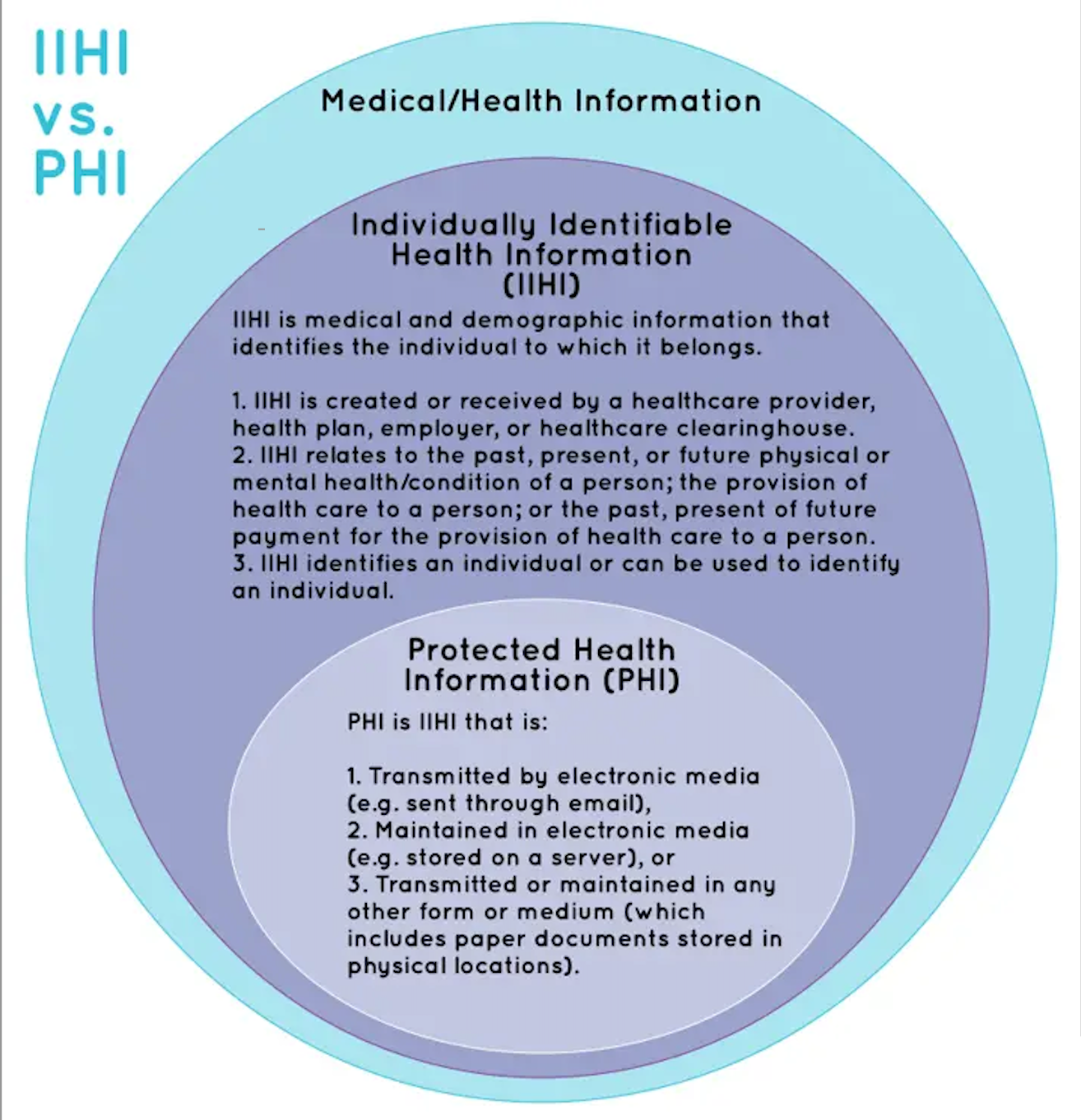
On a white background is a graphic of three concentric circles labeled from outer to inner "Medical/Health Information," "Individually Identifiable Health Information (IIHI)," and "Protected Health Information (PHI)." IIHI is described as medical and demographic information that identifies the individual to which it belongs. This circle has a list of 3 characteristics of IIHI: It is “created or received by a healthcare provider, health plan, employer, or healthcare clearinghouse,” “relates to the past, present, or future physical or mental health/condition of a person; the provision of health care to a person; or the past, present, or future payment for the provision of health care to a person.” The inner circle defines PHI as “IIHI that is: 1. Transmitted by electronic media (e.g. sent through email), 2. Maintained in electronic media (e.g. stored on a server), or 3. Transmitted or maintained in any other form or medium (which includes paper documents stored in physical locations).”
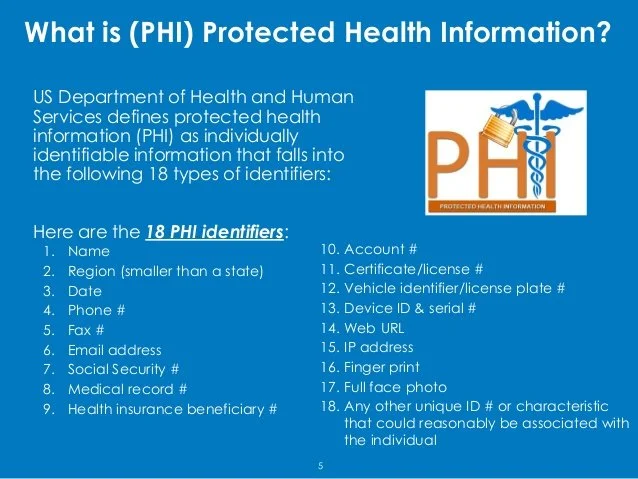
An infographic listing the 18 identifiers that define protected health information (PHI) according to the U.S. Dept. of Health and Human Services.
How to protect PHI
Please read this article on how providers must protect PHI to avoid HIPAA violations and potential legal consequences.